






Blogs
How Cloud and AI Are Shaping the Digital Future in the Middle East
Across the region, cloud and AI adoption are accelerating rapidly as governments and enterprises pursue national digital agendas, economic diversification, and competitive advantage. According to a study by Research and Markets[1], organisations in the region are moving beyond experimentation: by late 2024, nearly 60% of firms reported fast AI adoption, though only a minority had scaled it widely across business functions. Cloud sovereignty, regulatory compliance, and data governance have emerged as central concerns alongside speed of innovation.
National strategies signal that this isn’t transient. In the UAE, the UAE Strategy for Artificial Intelligence aims to embed AI across healthcare, transport, education, and government services by 2031, supported by dedicated ministries and data centre investments. Saudi Arabia, Qatar, and Bahrain are similarly investing heavily, positioning the Gulf as an emerging global AI hub.[2]
The expected US$320 billion impact of AI for the Middle East by 2030
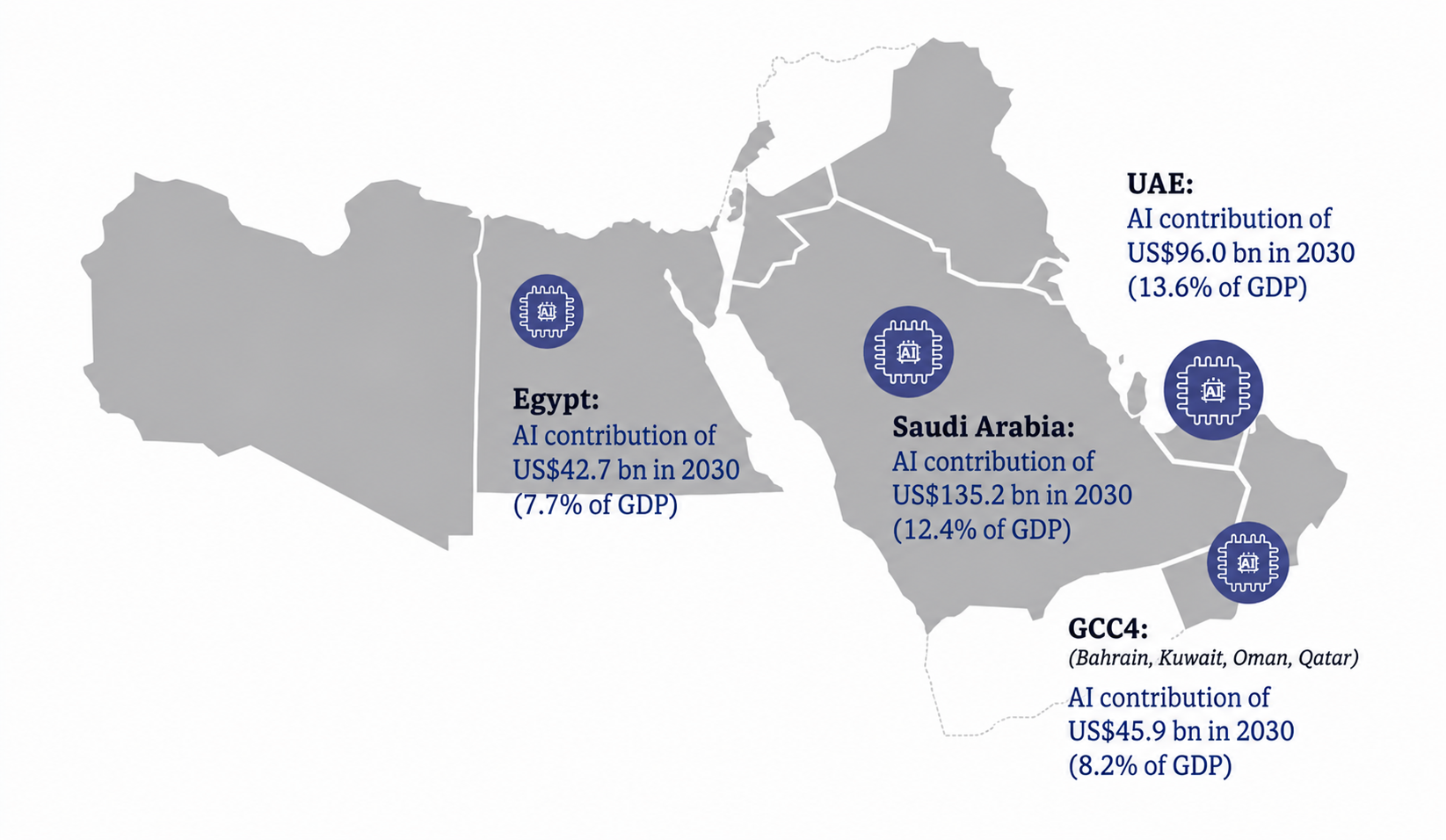
Cloud and AI adoption are also being shaped by compliance and infrastructure realities in the Middle East. As hybrid and sovereign cloud environments gain prominence, organisations must balance scalability with data residency, resilience, and regulatory alignment — factors that are now shaping procurement and investment decisions.
Lessons from Early Adopters Around the World
Globally, organisations that embraced cloud and AI early and adopted hybrid-by-design strategies that balance performance, sovereignty, and long-term flexibility have unlocked measurable value.
In the financial sector, banks like JPMorgan Chase have embedded AI into their cloud platforms to speed up model deployment, improve governance, and enhance customer experiences while maintaining strict compliance.
Automotive manufacturers such as Volkswagen are extending cloud partnerships to integrate AI across production lines, achieving operational efficiency and cost savings at scale.
These examples illustrate how cloud provides the elastic infrastructure needed for AI, while AI enhances cloud operations by automating resource management, predictive analytics, and real-time decision support — transforming both infrastructure and outcomes.
Why You Should Be Looking at Cloud and AI Implementation
For organisations of all sizes, the adoption benefits of cloud and AI are far-reaching, including:
- Agility and Scalability: Cloud infrastructure enables organisations to scale compute and storage on demand, supporting dynamic workloads and innovation without heavy upfront investment.
- Smarter Decision-Making: AI analytics can uncover patterns and insights across large datasets, enabling proactive insights and better strategic choices.
- Cost Efficiency: AI-powered automation and cloud’s pay-as-you-go models reduce operational costs, eliminate waste, and improve budget predictability.
- Innovation Enablement: Cloud combined with AI opens doors to generative AI, machine learning, and advanced analytics, positioning organisations to launch new products and services faster.
- Competitive Positioning: As digital transformation further becomes central to national economic visions, organisations that integrate cloud and AI effectively are better placed to lead innovation in sectors like energy, healthcare, finance, and government services.
Leveraging Cloud and AI Infrastructure
Successfully leveraging cloud and AI requires a deliberate, structured approach that protects the business and maximises value.
- Define Your Strategy and Use Cases: Start with business priorities and outcomes — focus on use cases where cloud and AI deliver measurable impact, such as predictive maintenance, customer experience, or supply chain optimisation.
- Assess Readiness and Infrastructure Requirements: Evaluate your current IT estate to determine the optimal cloud mix (public, private, hybrid) and the compute and data platforms required for your AI workloads.
- Establish Strong Governance and Compliance: Establish a Responsible AI framework that governs data usage, model risk, transparency, and compliance from the outset.
- Prioritise Security and Resilience: Security must be foundational, with continuous monitoring, detection, and response capabilities integrated across cloud and AI. Security architecture should evolve as workloads scale.
- Build Skills and Operational Capabilities: Invest in training and expertise or partner with specialists to close talent gaps, support ongoing optimisation, and manage complex environments responsibly.
The GBM-Cisco Advantage
Driving cloud and AI adoption securely and at pace demands capabilities that span strategy, technology, and operations. Together, GBM and Cisco combine global technology leadership with deep regional insight to support organisations throughout this journey, providing:
- Strategic Alignment: A clear roadmap that connects cloud and AI goals to specific business results and regional regulations.
- Future-Ready Infrastructure: Deploying secure, scalable hybrid platforms optimized for both high performance and data sovereignty.
- Integrated Governance: Building the essential frameworks to embed risk management and data oversight directly into your digital architecture.
- Continuous Protection: Leveraging GBM Shield’s cybersecurity and MDR services for 24/7 security monitoring and response, ensuring your entire ecosystem remains resilient as it scales.
Cloud and AI are redefining the Middle East’s business landscape. The leaders of the next decade will be those who scale these technologies with deliberate intent and robust security. Regardless of your infrastructure's complexity, GBM provides the roadmap to integrate cloud and AI while accelerating a secure, sustainable digital transformation.
Connect with a GBM expert today to begin unlocking lasting value.
.jpg&w=3840&q=75)